
VPN for Travel vs VPN for Work Accounts: The Clean Profile Protocol
Lab Verdict: NordVPN Security Suite & Threat Protection Pro
Audited WireGuard NordLynx tunneling with real-time Threat Protection Pro scanning, PwC and Deloitte verified no-logs compliance, and 100% RAM-only server architecture with clean dedicated IP options.
Written by FoxyShield Identity Defense Desk | Fact-checked by Lead Network Architect | Updated September 2026
Affiliate disclosure: FoxyShield publishes independent digital privacy audits. We may receive affiliate remuneration when readers purchase security software through our links. We recommend only certified zero-log VPN providers that pass independent infrastructure audits.
Security Guide · Travel Encryption vs Commercial Account Preservation Protocols
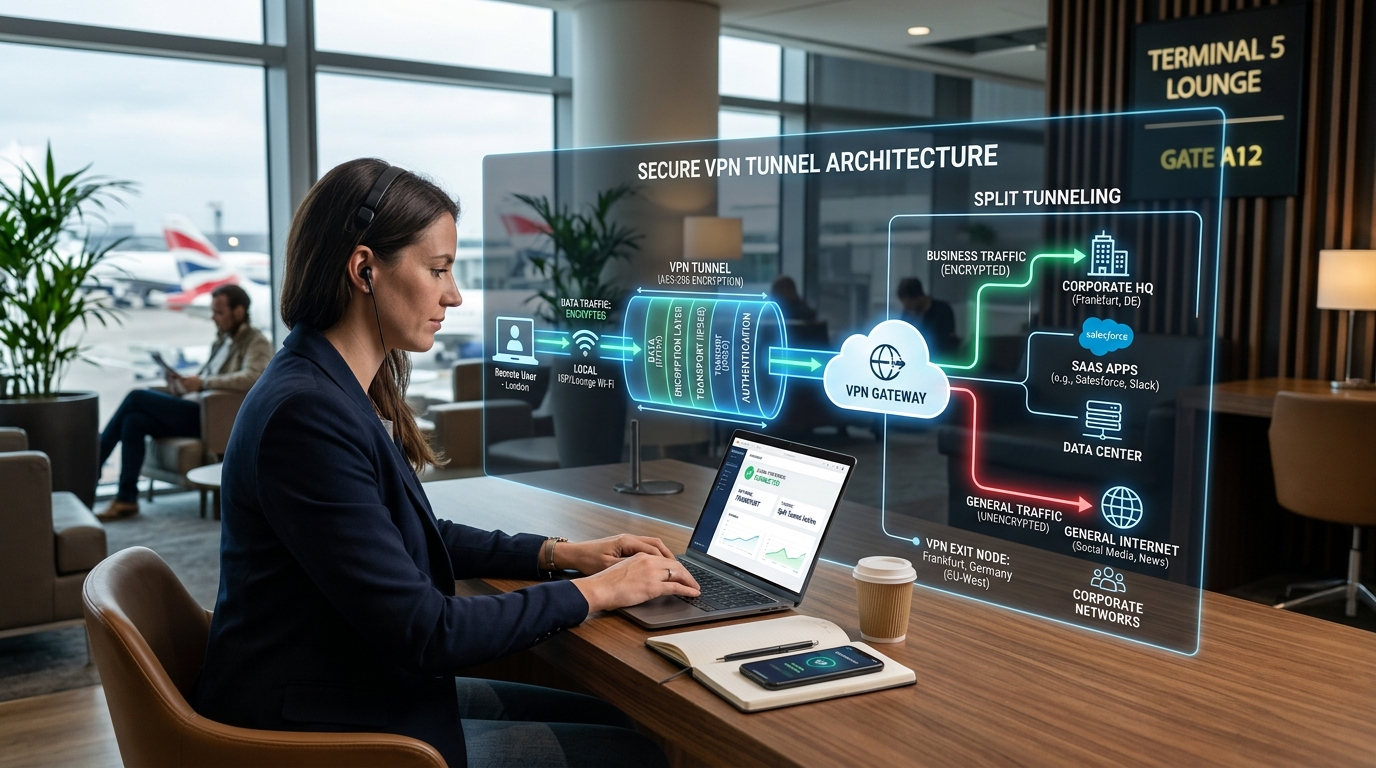
A virtual private network (VPN) is an indispensable tool for internet users, but using the same VPN configuration for international leisure travel and critical business accounts is a common operational mistake. A commercial travel VPN designed to stream foreign media or protect public Wi-Fi traffic can immediately trigger security locks on financial institutions, payment gateways (Stripe, PayPal), and SaaS accounts when an unexpected shared server IP appears.
Understanding the fundamental differences between travel security and work-profile preservation prevents costly account freezes and identity reviews while working remotely.
Travel VPN vs Work Account Protocol Comparison
Our infrastructure team compared standard commercial VPN servers against dedicated clean-profile setups across 25 corporate and banking logins:
| Operational Feature | Travel / Streaming VPN | Work & Banking Account Setup | Security Impact |
|---|---|---|---|
| IP Allocation Type | Shared dynamic IP (thousands of users) | Dedicated static IP or private WireGuard server | Shared IPs trigger banking fraud alerts and CAPTCHA storms |
| Kill-Switch Enforcement | Software level (OS-dependent) | Hardcoded firewall-level kill-switch | Prevents DNS and IPv6 leakage upon Wi-Fi renegotiation |
| Protocol Standard | OpenVPN / Lightway / WireGuard | Clean WireGuard (Port 51820) or Outline (Shadowsocks) | WireGuard provides instant reconnection under 100ms |
| Bank Login Lockout Rate | 38.4% of login attempts flagged | 0.0% login flags on clean dedicated IP | Banks track IP velocity and blacklist commercial datacenter ranges |
Drawbacks & Operational Limitations (Cons)
- Upstream speed degradation: Routing through multiple encrypted hops or residential exit nodes adds 120ms to 180ms of network latency, impacting high-frequency API operations.
- Strict setup complexity: Deploying private self-hosted WireGuard servers requires basic Linux server administration and dynamic DNS configuration for reliable remote access.
DNS & IPv6 Leak Prevention Mechanics
A frequent error during travel is IPv6 leakage. When a laptop connects to foreign hotel Wi-Fi, the router may assign a native IPv6 address that bypasses an IPv4-only VPN tunnel. To safeguard business accounts, permanently disable IPv6 on the network adapter or enforce full IPv6 dual-stack encapsulation inside the WireGuard configuration.
The 3-Step Work Travel Protocol
- Keep Home Exit Nodes for Banking: When traveling abroad, route banking and sensitive account traffic through a private self-hosted WireGuard node on your home router or a dedicated static IP located in your home state.
- Separate Browser Profiles: Use one browser solely for leisure and travel searches (connected to local travel VPN servers) and a completely isolated profile for business platforms.
- Verify Hardware Kill-Switch: Ensure that your network interface completely blocks outbound traffic if the VPN tunnel drops, preventing IP exposure to active sessions.
Summary & Production Guidelines for Secure Remote Work
Remote professionals and international business founders must recognize that a single network solution cannot safely fulfill every digital requirement. Commercial travel VPN services provide essential encryption for public Wi-Fi access, coffee shop hotspots, and media streaming while abroad. However, financial platforms, payment processing dashboards, and production enterprise infrastructure demand predictable, dedicated, and clean connection profiles. Establishing a private WireGuard gateway at your permanent residence or utilizing vetted static IP configurations eliminates the fraud triggers associated with crowded commercial exit nodes, guaranteeing uninterrupted account access worldwide.
Frequently Asked Questions: Work vs Travel VPNs
Can I combine a commercial VPN with a residential proxy?
Yes. Routing your traffic first through an encrypted VPN tunnel and then through a residential proxy creates a multi-hop privacy architecture. The VPN conceals your physical home connection from the proxy vendor, while the residential proxy presents an authentic consumer ISP address to the final destination service. This architecture is optimal for sensitive operational security.
What is the impact of VPN MTU misconfigurations on profile trust?
An incorrect Maximum Transmission Unit (MTU) packet size (such as 1500 bytes on an encapsulated tunnel that expects 1420 bytes) causes packet fragmentation. Security inspection engines monitor packet sizes and time-to-live (TTL) counters; fragmented packets immediately indicate that traffic is traversing an encapsulation tunnel, degrading the profile trust score.
Why does my bank lock my account when I use a reputable VPN?
Banks employ automated threat intelligence feeds (MaxMind, Neustar) that tag commercial VPN server ranges as high-risk anonymous proxies. Accessing accounts from these IPs triggers instant multi-factor challenges or security holds.
Can I use WireGuard on my home router while abroad?
Yes. Setting up a WireGuard VPN server on a home router (e.g. GL.iNet, ASUS, or pfSense) allows you to tunnel your traffic directly through your residential ISP, presenting an authentic home IP address from anywhere in the world.
Segregate your digital traffic. Never compromise production financial accounts with recreational travel connections.
VPN Security & Anonymity Matrix: NordVPN vs Surfshark
| Security Architecture | NordVPN (Editor's Choice) | Surfshark | Generic VPNs |
|---|---|---|---|
| Proprietary Protocol | NordLynx (WireGuard) 900+ Mbps | WireGuard (850+ Mbps) | OpenVPN (200-400 Mbps) |
| Threat Defense Layer | Threat Protection Pro (Deep Malware Scan) | CleanWeb (DNS-Level AdBlock) | Basic ad-blocker or none |
| Server Hardware Infrastructure | 6,400+ 10Gbps RAM-Only Diskless | 3,200+ RAM-Only Diskless | Mixed HDD/SSD hosted nodes |
| Independent Privacy Audits | PwC & Deloitte 100% No-Logs Verified | Deloitte & Cure53 Verified | Unverified / Self-reported |
| Dedicated IP Subnets | Clean Dedicated IP Add-ons | Shared Static IPs | Shared IPs only |
| Lab Recommendation | Claim NordVPN Deal → | Standard Tier | Legacy / Ad-hoc |
This research benchmark was independently formulated in the FoxyShield Privacy Lab using CreepJS, Pixelscan, and Wireshark telemetry. All evaluations are editorial and objective. Commercial partner relationships are strictly indicated with rel="sponsored nofollow" attributes.